Centre for close combat & self-defense in Villach
Friday:5:15 PM CFC Kids (ages 7–13)6:15 PM beginners & advanced (ages 14–99)
CFCCFC Villach

Wing Chun Kung Fu

Wing Chun in Villach – a training area at CFC Die Kampfkunstschule

5,0 ★ Google · Villach

Wing Chun is a martial art for close range: short paths, clear structure, little use of raw strength. At CFC in Villach you train it as part of a structured program – built up step by step, no experience needed.

Wing Chun Kung Fu training in Villach at CFC

Wing Chun Lexicon

Wing Chun explained – history, style, structure

Wing Chun is the style Headcoach Erich Ferlesch has trained and taught since 1995 – and the heart of the training at CFC. Here are the essentials at a glance.

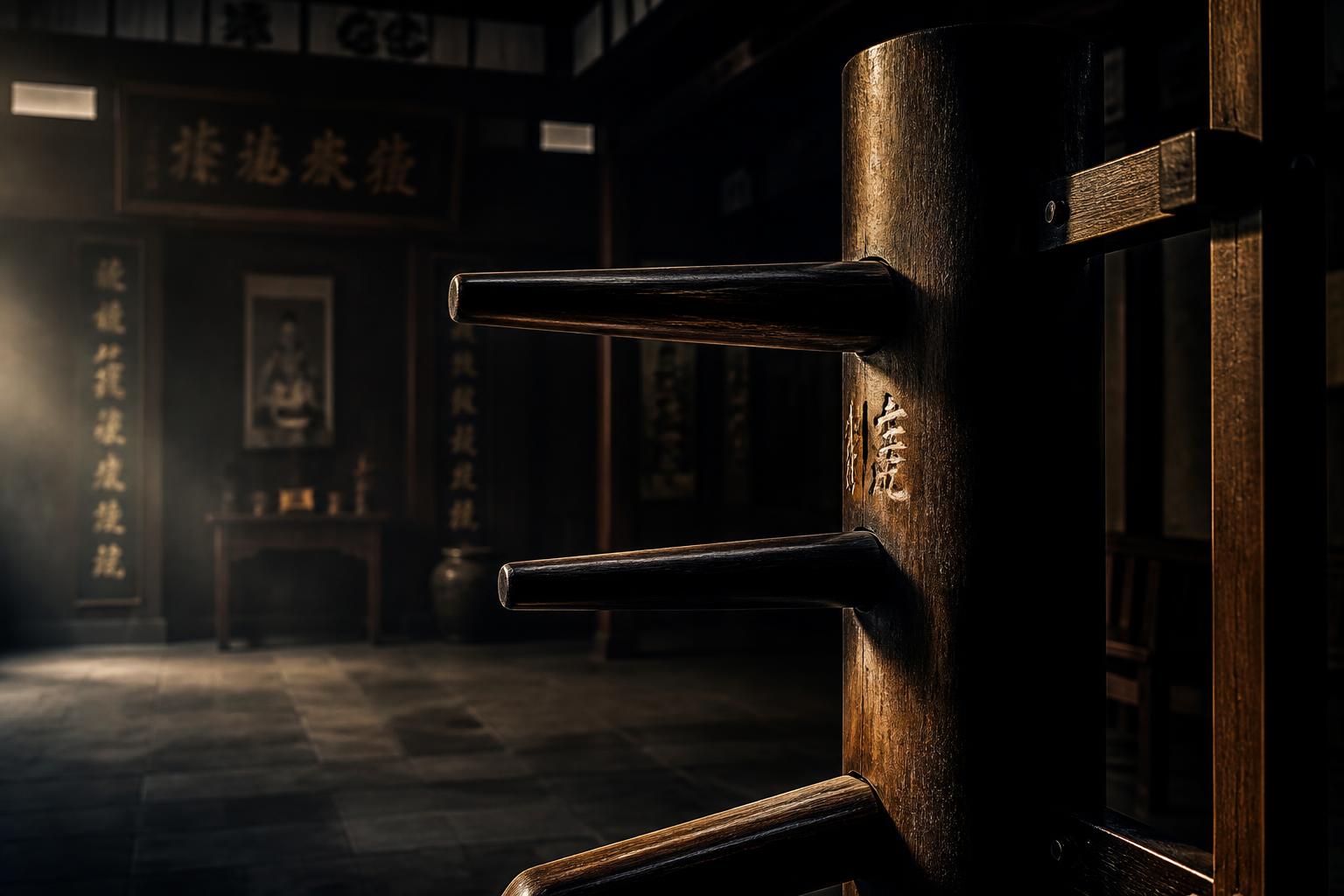
Wing Chun training on the wooden dummy (Muk Yan Jong)

History of Wing Chun

  • Origin: Southern China (Guangdong and Fujian provinces), usually dated to the 17th–19th century.
  • Legend: the nun Ng Mui is said to have developed the system after the destruction of the Southern Shaolin temple and passed it on to Yim Wing Chun – after whom the style is named.
  • Red Boats: in the 19th century Wing Chun was passed on among the opera performers of the “Red Boats” (Hung Suen).
  • Well-known lineage: Leung Jan, Chan Wah Shun and finally Ip Man (1893–1972), who taught Wing Chun publicly in Hong Kong from 1949.
  • Worldwide spread: through Ip Man's students – including Bruce Lee – Wing Chun became known internationally from the 1960s.
  • Note: many details of the early history are oral tradition and not clearly documented.
Wing Chun, Wing Tsun, Ving Tsun – why so many spellings?

They all refer to the same Chinese martial art 詠春 (Cantonese “Wing Chun”, literally “praising spring”).

  • Reason: Chinese characters have no Latin alphabet – every romanisation renders the Cantonese pronunciation slightly differently.
  • Wing Chun: the most common spelling internationally.
  • Wing Tsun: widespread in German-speaking countries, shaped by the Leung Ting lineage.
  • Ving Tsun: used mainly in Hong Kong and parts of Europe.
  • Other variants: Wing Tjun, Ving Chun, Wing Tchun and more – often used to distinguish an association or brand.
  • Mandarin pronunciation: Yǒng Chūn (Pinyin).
  • Bottom line: differences lie in spelling, organisation and teaching method – the root is the same.

The style and its advantages

  • Close range: Wing Chun is made for close combat – where space and time are short.
  • Centerline: attack and defense travel along the shortest line to the opponent.
  • Simultaneity: defending and striking happen in one movement rather than one after the other.
  • Redirect force instead of resisting it: works regardless of size, weight and strength.
  • Economy: a few clear principles instead of hundreds of single techniques.
  • Feel instead of guessing: through arm contact (Chi Sao) the body learns to react correctly to pressure.
  • Everyday benefits: posture, body awareness, calm and self-confidence improve outside training too.

Structure: what do you learn in Wing Chun?

  • Siu Nim Tao – “the little idea”: basic structure, stance, elbow position, relaxed power.
  • Chum Kiu – “seeking the bridge”: turning, stepping, body mechanics and contact with the opponent.
  • Biu Jee – “thrusting fingers”: emergency techniques, recovering the centerline, short power.
  • Muk Yan Jong – the wooden dummy: angles, position, footwork and precision against a fixed resistance.
  • Chi Sao – “sticky hands”: partner training for reflexes, sensitivity and timing.
  • Weapons for advanced students: long pole (Luk Dim Boon Kwun) and butterfly knives (Baat Jaam Dao).
  • Application: Lat Sao (free partner training) and self-defense under realistic pressure.
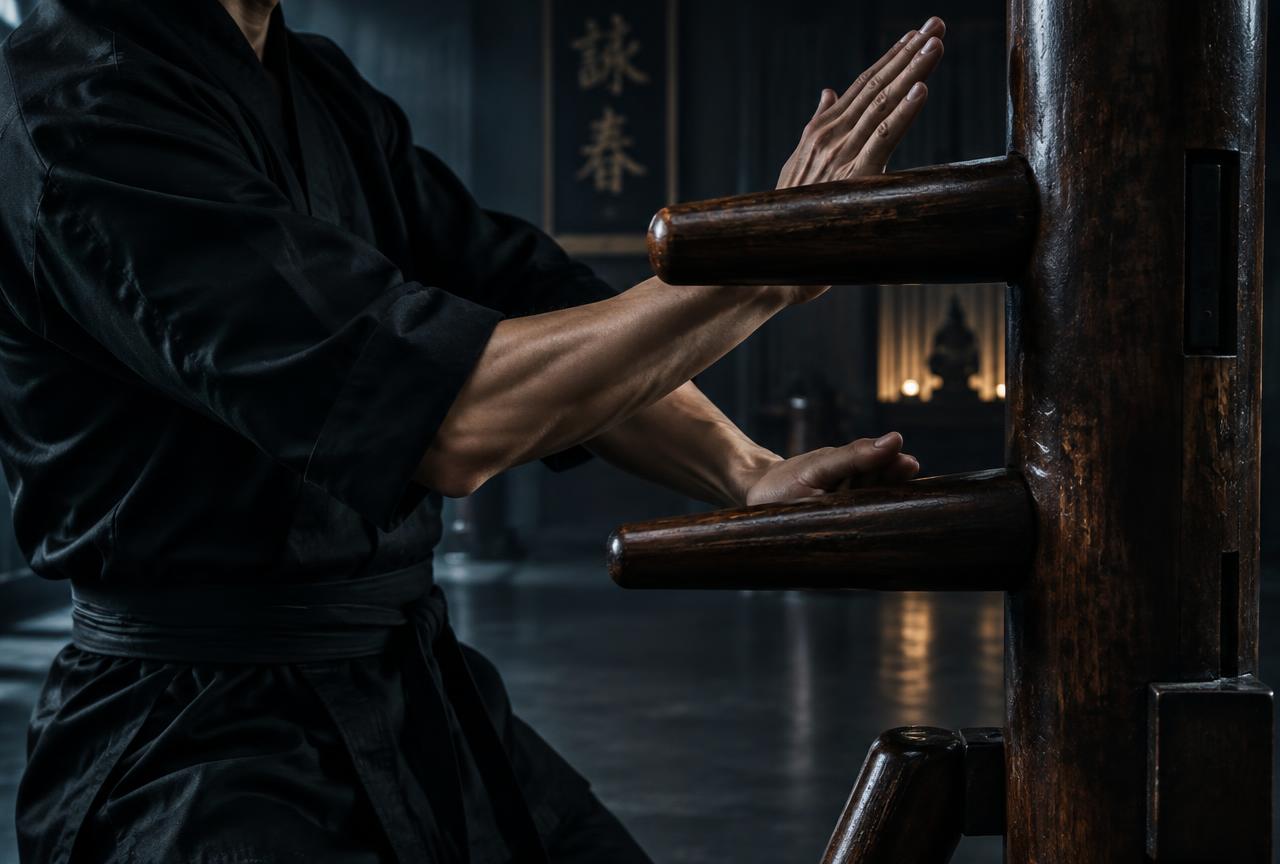
Wing Chun on the wooden dummy – stance and structure

The wooden dummy (Muk Yan Jong)

  • Wooden training device with three arms and one leg.
  • Trains angles, distance, footwork and clean coordination of arms and body.
  • Gradually conditions the forearms and improves precision.
  • Its own form: in the Ip Man lineage the dummy form has around 116 movements.
  • At CFC: an integral part of advanced training.

Yong Chun Quan – White Crane from Fujian

Yong Chun Bai He Quan (永春白鶴拳) is the White Crane style from Yongchun county in Fujian province.

  • Legend: founded by Fang Qiniang, a woman said to have observed the movements of a crane – a striking parallel to the legend of Yim Wing Chun.
  • Name: “Yong Chun” (永春, “eternal spring”) is the place name – it sounds almost like Wing Chun (詠春) but uses different characters.
  • Short power: explosive, short force generation (Jin) from body structure – similar to Wing Chun.
  • Basic form San Zhan (“three battles”): comparable to the structural work of Siu Nim Tao.
  • Close range and arm contact: both styles work with sticking contact and sensitivity in the arms.
  • Influence: Fujian White Crane also shaped Okinawan karate (e.g. Sanchin in Goju-Ryu).
  • Historians discuss a shared southern Chinese root of both styles – it is not clearly proven.

How this flows into training at CFC

  • Wing Chun is the heart of the training at CFC Die Kampfkunstschule.
  • Principles over style dogma: parallels with White Crane – short power, structure, arm sensitivity – are deliberately used in class.
  • Complemented by FMA (weapons training and knife training to improve coordination) and HEMA, so distances and weapons are covered realistically.
  • Structured progression from the first form to application under pressure.
  • Martial arts experience since 1990, Wing Chun since 1995, teaching since 1997 – Headcoach Erich Ferlesch.
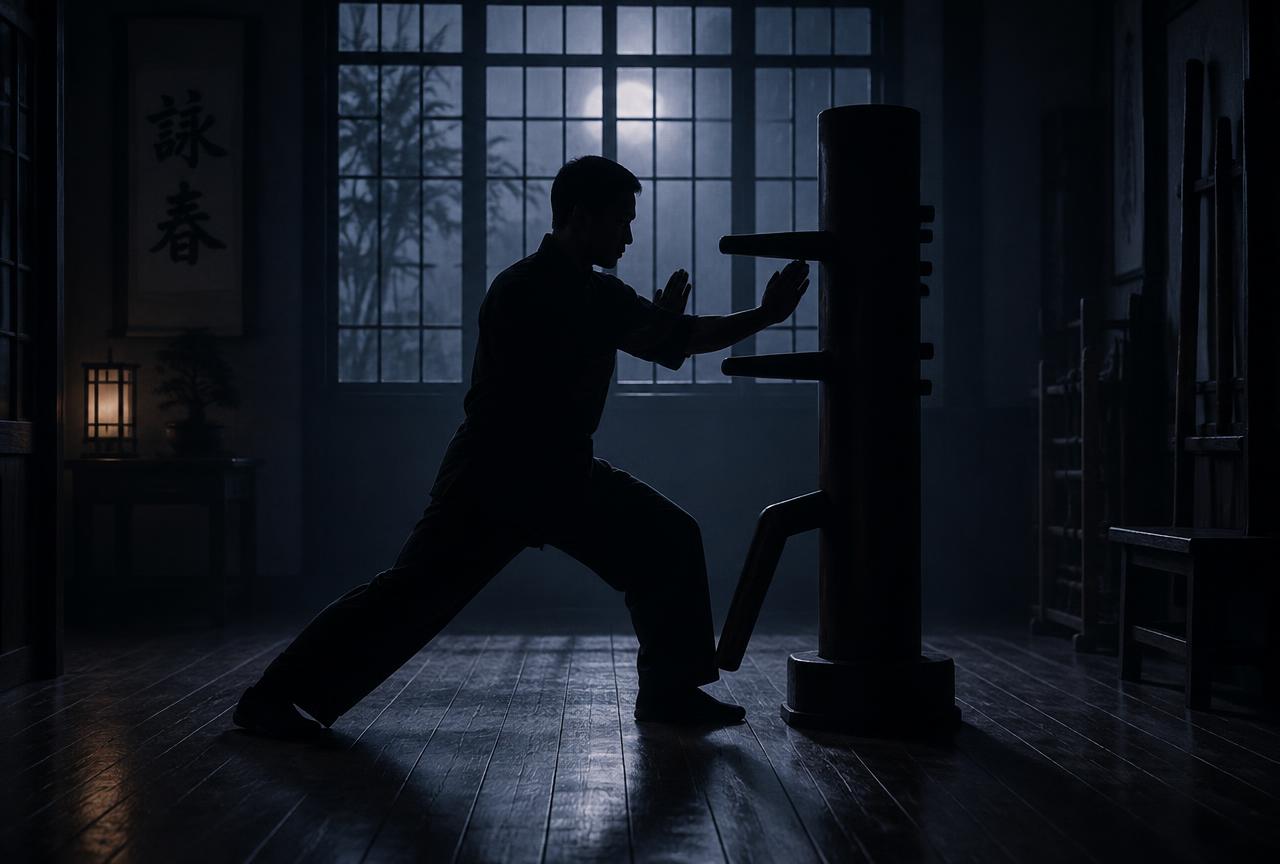
The Wing Chun wooden dummy (Muk Yan Jong)

Anti-Bullying for Teens

Wing Chun self-defense for teens: mental strength, clear communication and effective skills against bullying at school, in free time and on social media.

CFC at a glance

Location
Villach, Carinthia
Head instructor
Headcoach Erich Ferlesch (Sifu 師傅)
Experience
martial arts experience since 1990
Field practice
decades of experience in operational security
Training path
structured training path
Suitable for
beginners and advanced students

CFC offers Wing Chun training in Villach as part of a structured martial arts education. The program is under the training direction of Headcoach Erich Ferlesch, who has martial arts experience since 1990. Training takes place at Karawankenweg 13 in Villach, Carinthia – for beginners and advanced students.

How Wing Chun / Wing Tsun fits at CFC

Wing Chun is one of the three core styles at CFC Die Kampfkunstschule – equal alongside FMA – Filipino Martial Arts and HEMA – Historical European Martial Arts. It develops body structure, a feel for distance and timing at close range.

  • Works regardless of size and strength
  • Clear build-up: structure, distance, timing, application
  • Taught personally by Headcoach Erich Ferlesch
  • Start anytime – no prior experience required
  • No competition, focus on self-defense

Who is Wing Chun for?

  • Beginners who want to learn a martial art from the ground up
  • People who want to feel safer – calm rather than aggressive
  • Anyone building body awareness, timing and composure

What is Wing Chun?

Wing Chun is a close-combat system from southern China. It works at short range – where there is little space and even less time. Instead of many single techniques, a few principles matter: stable structure, short paths, defending and acting at the same time, redirecting force instead of meeting it head-on.

Wing Chun belongs to Kung Fu (Gong Fu, 功夫)

Wing Chun (詠春) belongs to the Chinese martial arts, commonly known as Kung Fu. The correct transcription is Gong Fu (pinyin: gōngfu, 功夫), originally meaning “skill acquired through time and effort”; the Chinese umbrella term for martial arts is Wushu (武術). Three spellings are in common use: Gong Fu, Kungfu (one word) and Kung Fu (two words). In short: Wing Chun Kung Fu is a southern Chinese close-combat system within the Kung Fu family. You will find an overview of other systems in our martial arts lexicon.

How does CFC teach it?

We do not teach technique after technique, but skills: structure, distance, timing, movement and application under pressure. Partner drills such as Chi Sao train your reaction to what is actually happening. Every session builds on the last, at a pace tied to your progress.

Why train at CFC?

CFC is the center for close combat and self-defense in Villach. Wing Chun is one of the three core styles at CFC Die Kampfkunstschule, equal alongside FMA – Filipino Martial Arts and HEMA – Historical European Martial Arts. Training is led by Headcoach Erich Ferlesch: martial arts experience since 1990, decades of operational security experience.

How to get started

You request a trial lesson, we briefly clarify your goals and experience and place you in the right group. The fee for the first CFC training module is already a first modular training service.

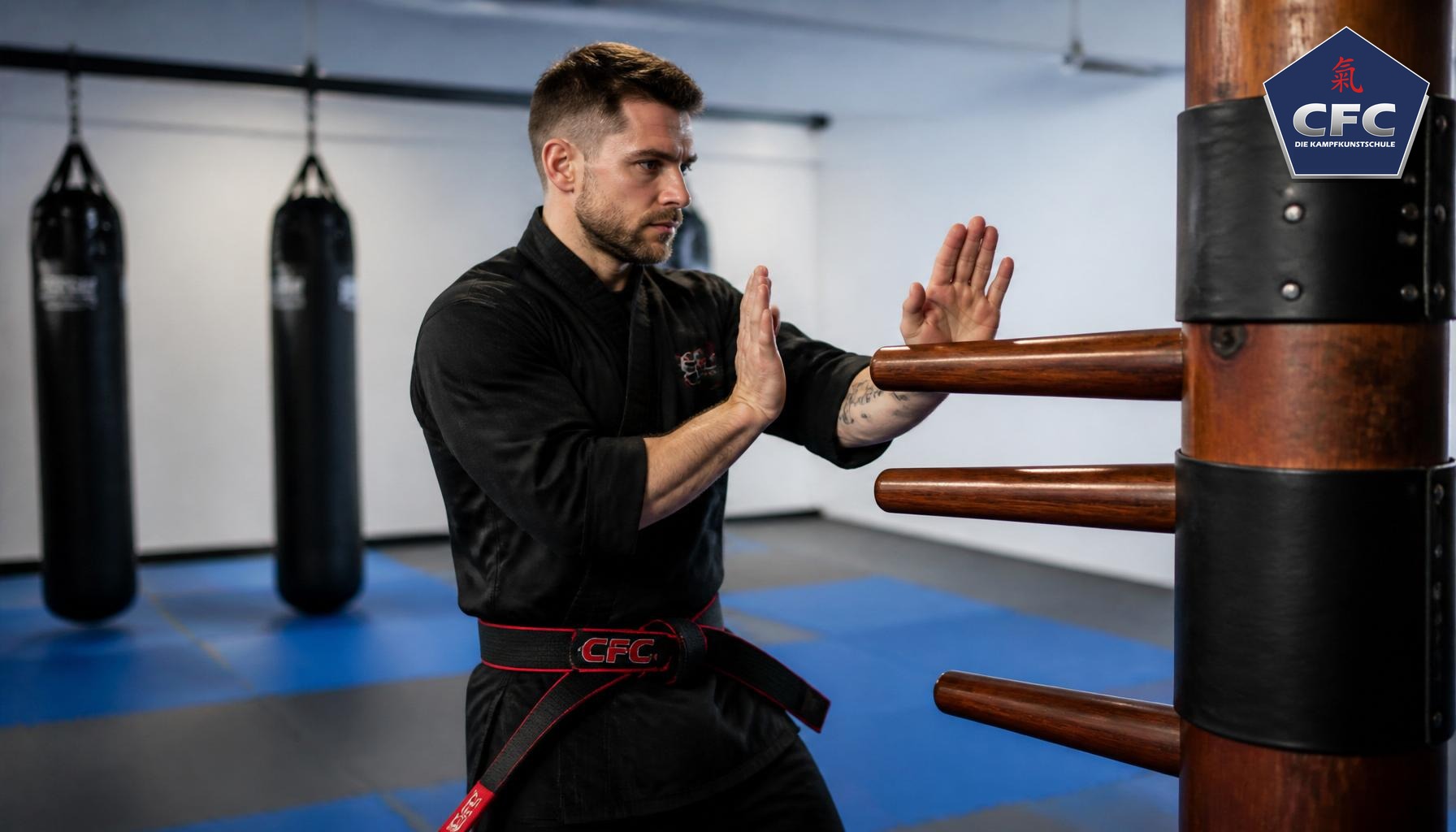
Wing Chun wooden dummy training with CFC logo in the training hall in Villach

Frequently asked questions about Wing Chun in Villach

Do I need prior experience?

No. You can start anytime – beginners and advanced students train together.

Who teaches the classes?

Headcoach Erich Ferlesch, founder of the school, leads the sessions personally.

Where does the training take place?

At Karawankenweg 13 in Villach – easy to reach from anywhere in Carinthia.

Are there competitions?

No. We train without competition and without rule sets – the focus is self-defense.

What do I need for the trial lesson?

Comfortable sportswear and clean non-slip socks. Nothing else.

How often should I train?

Once a week is enough for solid progress. You can come more often if you want to advance faster.

How does the trial lesson work?

You reserve a slot online and then receive a personal confirmation from us. On site we briefly discuss your goals, after which you train in the regular group. The first training module is already a first modular training service.

How is a training session structured?

Warm-up and mobilisation, then structure and technique work, followed by partner drills such as Chi Sao and finally application under light pressure. A session lasts around 60 to 75 minutes.

What level is the training at?

Beginners and advanced students train together, with exercises adapted individually. You start with the fundamentals and increase pace and pressure at your own rhythm – nobody is pushed beyond their level.

How do I arrange an appointment?

Training times on request – dates and training format by personal arrangement. Call +43 676 5205470 or email office@cfc-combat.com.

Related pages

Take the first step into CFC training

Get to know CFC in person and take the first step into your training in close combat and self-defense.